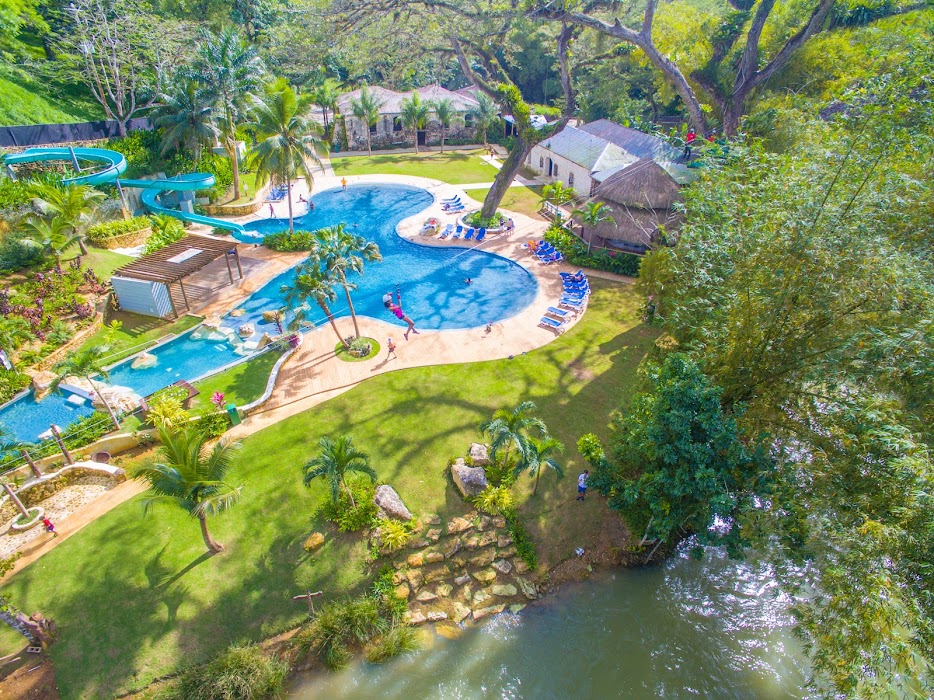
Chukka's Good Hope outpost is an adventure park built inside an eighteenth century sugar plantation near Falmouth, on about 2,000 acres wrapped around a bend in the Martha Brae River. You zipline, tube, raft on bamboo and swim under a 50 foot waterfall. The thing worth knowing before you go is whose ground this is: Good Hope belonged to John Tharp, who by the end of the eighteenth century was the largest slaveholder in Jamaica, with more than 2,800 enslaved people recorded across his estates.
History
1744, and a bend in the Martha Brae
Good Hope began in 1744 as a 1,000 acre sugar plantation on a land grant held by Colonel Thomas Williams, cleared out of forest along the Martha Brae in what was then eastern St James. The parish of Trelawny did not yet exist; it was split off in 1770 because the planters of this district thought Montego Bay too far to ride for business. The oldest surviving part of the great house, the south gable wing, dates to around 1755.
John Tharp
In 1767 the plantation and the people enslaved on it were bought by John Tharp, an Anglo-Jamaican planter of 23. He did not inherit a slave-holding operation and improve it at the margins. He built it into the largest in the colony. By the 1790s he controlled seven contiguous sugar estates and two cattle pens, roughly 9,000 acres, and served as Custos of Trelawny. The probate inventory taken after his death in 1804 records more than 2,800 enslaved people across those estates, 484 of them at Good Hope itself.
Almost everything you will walk past was built by those people, during Tharp's building campaign of 1790 to 1802: the store house of 1790, the counting house, the coach house, the water mill and its works, and a hospital for the enslaved put up in 1798. A plantation needing a hospital of that scale is not a detail about medical care. It is a measurement of how many human beings were being worked here and how hard.
Archaeological survey of the enslaved village began in 2014 and records an average of 414 people living there annually in the early nineteenth century, peaking around 1803. The Jamaica National Heritage Trust's own record of the property notes that Tharp fathered a daughter with an enslaved woman and settled an annual income on her, which was the ordinary shape of power on a Jamaican estate and should not be read as anything softer than that.
After 1838
Sugar here outlasted slavery by four decades. Full emancipation came in 1838, Frederick Robert Coy bought Good Hope in 1840, and sugar and rum production carried on until 1878. The estate then passed through several hands before an unexpected second life: from the early 1920s until 1950 it operated as the Good Hope Hotel, a resort for wealthy Europeans, British royalty and Jamaica's late colonial establishment. Chukka Caribbean Adventures, the Jamaican owned operator named after the period of play in a polo match, took the property on as an adventure outpost. Villa accommodation still runs alongside it in the historic buildings.
What it costs and when it opens
Chukka sells this as packages rather than gate admission, and the prices move, so treat these as the shape of the thing rather than a quote. The Estate Pass, covering the pool complex, waterfall, grounds and lunch, starts around US$89 per person. Zipline and river tubing packages run around US$140. The full combination, bamboo rafting plus zipline plus tubing plus a buggy, has been listed around US$218. Locker hire is about US$10. Transport packages from Montego Bay or Ocho Rios include hotel pickup and take most of the day, with typical start times around 10am and an eight hour window door to door.
What it is actually like
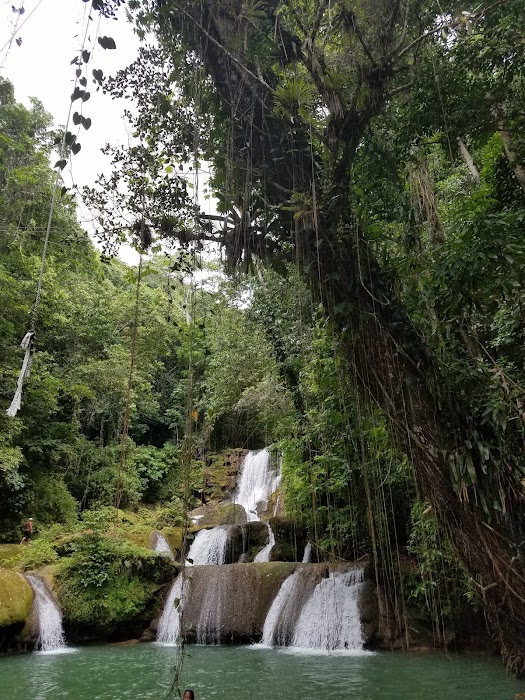
Bigger and greener than the coastal outposts, with Cockpit Country rising behind it. The centrepiece for most families is Adventure Falls: a zero entry pool and waterslide feeding six wading pools that step down to a 50 foot waterfall, which means small children and grandparents have somewhere to be all day while everyone else is on the wire. The zipline runs through jungle canopy, the tubing and bamboo rafting are both on the Martha Brae, and there is an Appleton rum tasting, a bird aviary, buggies, ATVs, e-bikes and horses.
The great house tour is the part people skip and should not. It is also the part where the day gets honest, and how much history you get depends heavily on which guide you draw. Ask directly about the enslaved village and the 1798 hospital. Good guides here know the material.
What to bring
- Closed shoes with grip for the zipline and buggies, plus sandals for the pools
- Swimwear under your clothes, you will not want to waste the changing time
- A strap or waterproof case if you insist on carrying a phone
- Cash for tips and the bar, and a change of dry clothes for the drive
How it fits a day
This is a full day, not a stop. Good Hope sits inland from Falmouth, roughly 45 minutes from Montego Bay and a little over an hour from Ocho Rios, and the drive up through the cane land is part of it.
YaadBinge runs it 9.30am to 4pm: the adrenaline activities first while it is cool and the platforms are quiet, the great house tour late morning, lunch, and the falls and pools through the hot part of the afternoon when nobody wants to be in a harness. Do not stack a beach in front of it. Falmouth town, with its Georgian streets built on the same sugar money, is a sensible half hour on the way back if you still have light.