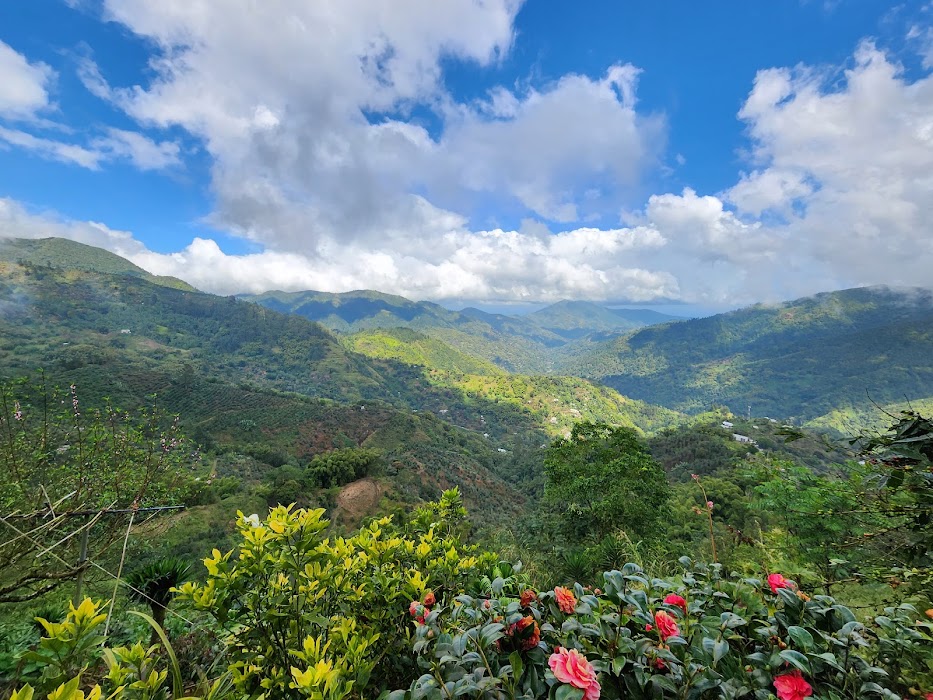
The Blue and John Crow Mountains are on the UNESCO World Heritage list for two reasons at once: the forest, and the fact that enslaved Africans used it to beat the British Empire. The catch is that most visitors never leave Holywell, an hour from New Kingston, and never see the Maroon heritage the listing is about.
History
Nanny, Quao and the Windward Maroons
When the English took Jamaica from Spain in 1655, enslaved Africans on the Spanish estates went into the mountains rather than into English hands, and others escaping English plantations followed. Nanny and her brother Quao founded the settlement that became Nanny Town, in the ridges above the Rio Grande.
The terrain did the fighting. Sheer ridges, dense forest, permanent cloud and hundreds of streams gave the Maroons ambush ground while British columns carried everything uphill. In 1734, after roughly two decades of war, a force under Captain Stoddart hauled artillery up to Nanny Town and destroyed it, claiming to have killed everyone there. He had not. Survivors regrouped at what became Moore Town, and the original site was never rebuilt.
The clause nobody puts on the poster
Britain could not win, so it settled. Cudjoe signed the Leeward treaty on 1 March 1739, and the Windward Maroons under Quao signed their own soon after. They got freedom, recognised towns and land, 1,500 acres for the Leeward side and around 500 for the Windward.
They also got obligations. Article 9 of the Leeward treaty required any enslaved person who ran away and fell into Maroon hands to be sent back to the chief magistrate of the nearest parish, with a payment for each one delivered, and Article 6 bound Cudjoe to take, kill, suppress or destroy rebels. The Windward treaty carried the same duties in its Article 4. After 1739 the colonial government used the Maroons as an internal police force against runaways and slave risings. That is the price of the freedom, and Jamaicans have argued about it ever since.
Nanny was named a National Hero in 1975 and remains the only woman among them. She is on the J$500 note, which Jamaicans simply call a Nanny.
Park, listing and coffee
The national park was established in 1993, Jamaica's first, and covers around 41,198 hectares. It is run by the Jamaica Conservation and Development Trust, which states plainly that government funds cover only about 30 per cent of its budget. That is why there is a gate fee on a mountain.
On 3 July 2015 it became Jamaica's first World Heritage Site, and a mixed one, listed under both cultural and natural criteria. The cultural case rests on the Nanny Town Heritage Route: secret trails, settlement sites, lookouts and archaeological remains, cited as exceptional evidence of grand marronage. The natural case rests on the endemics, among them Papilio homerus, the largest butterfly in the Americas, critically endangered, with one of its last two populations here.
What it costs and when it opens
Holywell, the main recreation area, sits above 900 metres, about an hour from New Kingston. Entry is around US$10 for non resident adults and US$5 for children, or roughly J$100 and J$50 for residents. Ranger stations generally run 9am to 5pm. Cabins are around US$60 to US$80 a night and camping about US$5 a head, booked ahead through the JCDT office.
The Peak trail has its own fee, roughly US$20 for non residents and about J$200 for residents, paid when you register at Portland Gap. Prices move, so confirm with JCDT.
What it is actually like
Holywell is a picnic and short walk destination, with five nature trails from 350 metres to 1.3 km: cool, misty, frequently wet, and a shock after Kingston's heat. Weekends bring Kingston families. Weekdays it is close to empty.
Blue Mountain Peak is a different proposition. At 2,256 metres it is Jamaica's highest point, and the standard approach is to start near Penlyne Castle around 1am to reach the summit for sunrise. The trail is roughly 9 km each way, the final 5.6 km taking two to three hours. Cloud wins often enough that a clear sunrise is luck, not a plan.
What to bring
- A warm layer and a waterproof, whatever the Kingston forecast says.
- A head torch plus a spare, for the peak.
- Two litres of water each and food. Nothing is sold above Irish Town.
- Cash in Jamaican dollars, and boots with grip.
How it fits a day
These are two different bookings. Holywell is a half day: leave Kingston around 8am, at the gate by 9.30am, walk and eat, stop at a coffee estate coming down, back in town by about 3pm.
The peak eats a night and a day. Drive to Penlyne Castle the afternoon before, sleep four hours, walk from 1am, summit near 6am, back in Kingston by early afternoon and wrecked. Do not stack anything after it.