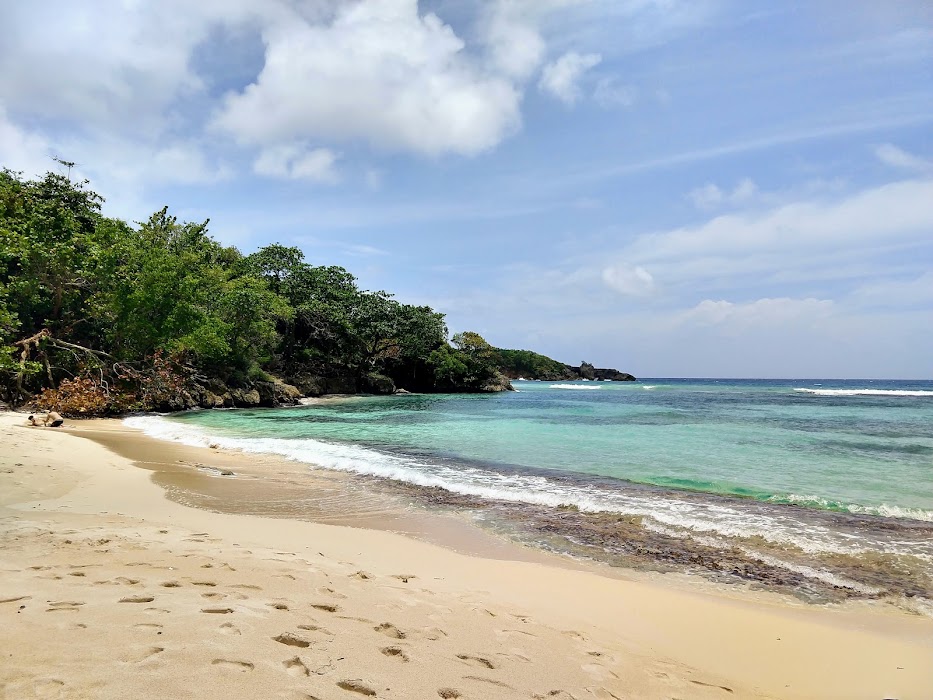
Winnifred is free, and it is free because a handful of vendors and residents took the Government to court and won. There is no gate, no wristband and no chair rental empire. There is a steep concrete track down through the trees, a crescent of sand at Fairy Hill in Portland, and a row of cook shops run by the same people who cleaned the beach through seven years of litigation.
History
A missionary's will, 1918
The land came into community hands through a Baptist missionary named Frederick Barnet Brown. In 1918 Brown willed his Fairy Hill estate to his wife, with the instruction that on her death the property should serve as a rest place for missionaries, teachers and the poor, and he set up a trust to hold it for the Fairy Hill community. The trust was not administered well. By 1938 Jamaica's Attorney General had become sole trustee, and in 1972 most of the property, Winnifred Beach included, passed to the Urban Development Corporation, the state agency that has held the title ever since.
Where the name Winnifred itself comes from is not settled. It is repeated locally that the beach carries the name of a woman in Brown's family, but we have not found a document that confirms it, so we will not state it as fact.
Fairy Hill Phase 2, and the case
Around 2007 the UDC moved to clear vendors and restrict access, under a development scheme for the surrounding land. That was the trigger. Two of the people who made their living on the sand, the vendor Barry Allen and the cook Cynthia Miller, joined with residents and filed against the corporation.
The legal argument was not that the community owned the beach. It was that Jamaica's Prescription Act gives the public an indefeasible right of way where a right has been enjoyed openly and without interruption for twenty years or more, and Fairy Hill had been walking down to that sand for far longer than twenty years. Yvonne Ridguard, a Portland attorney, took the case pro bono. Maria Carla Gullotta, an Italian-born human rights activist living in Jamaica, helped the community organise itself formally into the Free Winnifred Beach Benevolent Society, which had been maintaining the beach since 2004.
6 October 2014
It ended in mediation rather than judgment. On 6 October 2014, after roughly seven years, the Port Antonio court entered a consent order. The UDC keeps the freehold. In exchange an easement was granted to be recorded on the title, guaranteeing public access for bathing and recreation in perpetuity. That easement is the whole reason you can walk onto this beach today without paying anyone.
The surprising part is who has been running it since. The state owns the land, but the Benevolent Society does the cleaning, the garbage collection and the bathroom upkeep, and has done for more than fifteen years. Arguments about who should fund proper facilities are still live. A Tourism Enhancement Fund consultation drew over a hundred residents in March 2022, and the community has since complained that nothing concrete came back to them.
What it costs and when it opens
There is no entrance fee and no fixed hours. Someone will usually ask for a small contribution towards upkeep at the top of the track, and often something for watching the car. It is a donation, not a gate fee, and roughly US$2 to US$5 is normal. Food at the cook shops runs cheap by Jamaican beach standards, in the region of US$8 to US$15 for a plate of fish. Daylight hours only. There are no lights and no lifeguards.
What it is actually like
Small, curved, shallow and green rather than turquoise, with a reef breaking offshore that keeps the water calm. A mineral spring feeds into it, which is part of why it runs so clear. Sea turtles nest here.
The far end is where the food is. Cynthia's, and the other huts beside it, cook to order over fire, which means you wait, sometimes a long time. Order when you arrive rather than when you are hungry. Weekends are a Jamaican beach in the proper sense, families, sound systems, domino, and it fills up. A Tuesday morning you may have most of it.
Be honest with yourself about facilities. The bathrooms are basic and their condition has been a running public argument for years. This is not a resort beach and does not pretend to be one.
The access road is a short, steep, broken concrete track. In a low car or after rain it is genuinely difficult, and many drivers park at the top and walk down. Coming back up on foot in midday heat catches people out. There is no lifeguard on this beach at any time.
What to bring
- Small Jamaican cash. Nobody here takes a card.
- Water shoes if your feet are soft. There is rock and sea grass in places.
- Your own towel and shade. There is no chair rental operation.
- A bag for your rubbish, out of simple respect for the people who clean this beach for nothing.
How it fits a day
Winnifred works as the long middle of a Portland day, roughly 11am to 4pm, because the food is slow on purpose and you should not rush it. Put Blue Lagoon or the Rio Grande before it and Boston Bay after, since Boston is twenty minutes east and jerk is at its best in the late afternoon. Do not try to fit Winnifred into a Kingston day trip and back. The drive across the island each way is long enough that you would spend the day in the car.