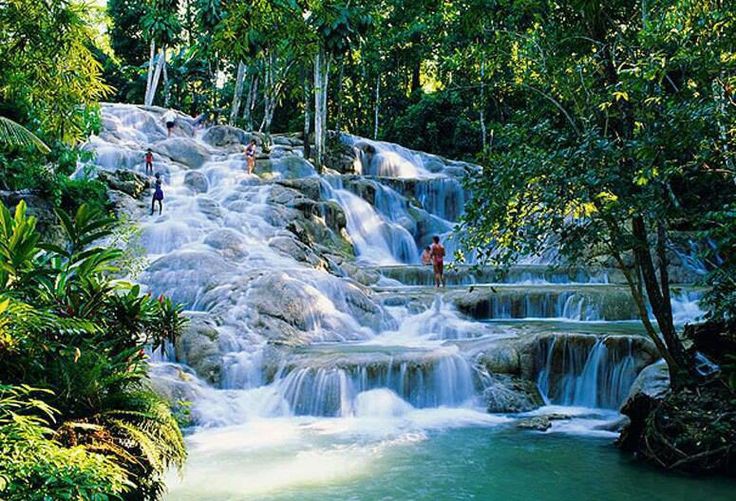
Six hundred feet of terraced limestone that you climb, in the water, holding the hand of the person in front of you. It is the most photographed place in Jamaica. It is also a real physical climb, and a battlefield, which the brochures tend to leave out.
The battle at the bottom of the falls
On 30 October 1657, the ground where the falls meet the sea was the site of the Battle of Las Chorreras. A Spanish force under Cristobal Arnaldo Isasi, trying to retake Jamaica after the English invasion of 1655, was beaten by an English force under the acting governor Colonel Edward D'Oyley. The Jamaican Historical Society placed a plaque at the foot of the falls to mark it. Most people walk straight past it on the way to the changing rooms.
Why Ocho Rios is a misunderstanding
The Spanish called this stretch of coast Las Chorreras, meaning the waterfalls, or the springs. Over centuries of English tongues the name wore down into Ocho Rios, which reads as "eight rivers" and has been translated that way on tourist maps ever since.
There are four. Cave River, Roaring River, Turtle River and Dunn's River. The town is named after a mishearing, and the falls are the thing the original name was describing.
A waterfall that builds itself
Dunn's River is a travertine waterfall, which is rare, and is the reason it can be climbed at all. The water carries dissolved limestone and lays it back down as it flows, so the terraces are constantly rebuilt by the river running over them. It is one of the few waterfalls actively growing rather than eroding. The steps under your feet were made by the water you are standing in.
What it costs and when it opens
Entry is around US$25 for adults and US$17 for children aged 4 to 12, including the guided climb and the beach at the bottom. Lockers are about US$10, with a few dollars returned with the key.
Gates are usually 8:30am to 4:00pm, opening at 7:00am on cruise ship days. If you intend to climb, be through the gate by 2:00pm.
What the climb is actually like
The falls rise roughly 180 metres in natural steps and pools. A guide leads each group, everyone links hands, and you go up through the moving water rather than beside it. The climb takes 45 minutes to an hour. Allow 90 minutes to two hours for the whole visit with changing and beach time.
You cannot climb without a guide, and that is a sensible rule rather than a sales one. The safe line up shifts with the water level, and only a guide who was here yesterday knows where it is today.
A dry path runs alongside for anyone who would rather watch. Only the wet climb reaches the top.
What to bring
- Closed toe water shoes with real grip. The single thing people get wrong. Flip flops and bare feet do not work on wet travertine, and the rental pairs go early.
- Swimwear you can climb in, plus dry clothes and a towel.
- A waterproof pouch for your phone. You will be fully in the water.
- Cash for the guides and the official photographs at the exit.
- Sunscreen and repellent. The lower falls are shaded, the top is open.
How it fits a day
We put Dunn's River first, at 9:00am, with two and a half hours on it. Early means climbing before the cruise groups arrive, and it leaves the afternoon for something that does not use your legs. Jerk lunch after, then river pools or a beach. Nobody wants to climb a waterfall at four in the afternoon.