Ocho Rios Jerk Centre has been at 14 DaCosta Drive since 1995, and unlike most jerk pits in Jamaica it seats you at a table and brings the food to you. The honest catch is that this is a busy open air restaurant on a main road in a cruise town, not a smoky roadside drum, and it is priced accordingly.
History
The word came from Peru
Jerk has nothing to do with jerking or pulling. The word descends from the Spanish charqui, itself borrowed from the Quechua ch'arki, meaning dried meat. It is the same root that gives English the word jerky. Spanish colonists carried the verb charquear into the Caribbean after the conquest of the Andes, and it stuck to a Jamaican method that was not Spanish at all.
The Taino were first
The technique predates the Spanish and the Africans both. Jamaica's Taino people cooked and preserved meat and fish on a wooden frame over slow fire, the barbacoa that eventually became barbecue, seasoning with the peppers and the pimento that grow wild here. The Spanish chronicler Gonzalo Fernández de Oviedo y Valdés described the method in print in 1516, which makes it one of the earliest written records of any Caribbean cooking technique.
The Maroons, and the smoke
In 1655 an English fleet took Jamaica from Spain. The retreating Spanish freed the people they had enslaved, partly to deny the English the labour, and those men and women went into the interior. Joined over the following decades by others who escaped the English plantations, they became the Jamaican Maroons. They met the surviving Taino in the mountains, and jerk is what came out of that meeting: an indigenous smoking method, African seasoning practice, and the wild hog that the Spanish had left running loose.
The famous part of the story is the pit. Meat was rubbed with salt, pimento berries, bird peppers and aromatics, wrapped in pepper elder leaves, and cooked slowly in an earth pit over smouldering pimento wood so that almost no smoke escaped. Smoke above a mountain ridge tells a British patrol exactly where you are.
What the freedom cost
The First Maroon War ran from 1728 to 1739. The British could not win it. Cudjoe signed for the Leeward Maroons in 1739, negotiating with John Guthrie and John Campbell, Quao signed for the Windward side on 23 December 1739, and Nanny's treaty followed in 1740. The Maroons kept their land and their towns, Trelawny Town, Accompong, Moore Town, Scott's Hall and Nanny Town, and their formal freedom.
The price was written into the treaty. They agreed to return any enslaved people who escaped to them afterwards, and to help the British put down rebellion. Free people were bound by contract to hand other people back into slavery. That is part of the history of the food, and it is usually left off the menu board.
From the mountains to the roadside
Jerk stayed largely a Maroon and country practice for two centuries. Selling it is recent. Commercial jerk as an industry is generally traced to Boston Bay in Portland in the 1940s, where vendors moved the fire above ground onto raised grills over pimento wood, then onto split oil drums under zinc roofs. That is the format now standing on every main road on the island, including this one.
What it costs and when it opens
Open daily from 11am, closing around midnight Monday to Thursday and around 1am Friday to Sunday. Phone is (876) 974-2549. The menu is not published as text online, so treat figures loosely: reviewers report typical plates in the region of J$2,000 to J$4,000, roughly US$13 to US$26, with lobster well above that. Prices are quoted in Jamaican dollars, so check the rate you are being given if you pay in US.
What it is actually like
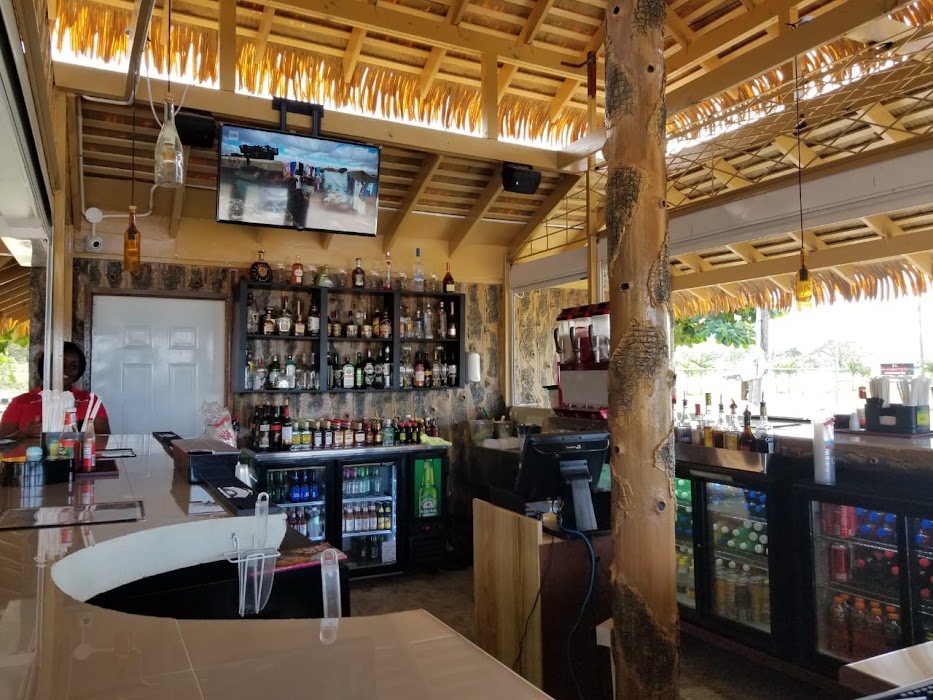
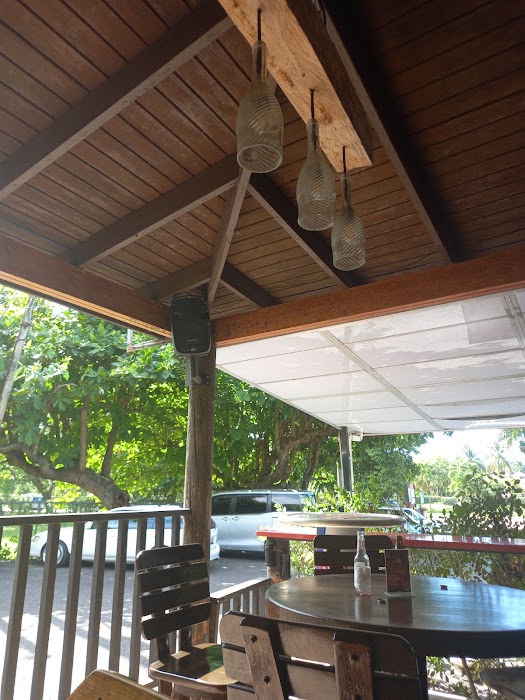
Open sided, roofed, loud, with a full bar and live music on weekend nights. Jerk pork, jerk chicken, jerk sausage, fish, conch and whole lobster, plus wings and the usual sides. Table service is the real difference from a drum pit, and it means you can sit for two hours rather than eat standing over a paper plate.
It is a mixed room of locals, taxi drivers and visitors, and it gets busy from about 7pm on Friday and Saturday. Ask for the pork. Jerk chicken travels well and is what most visitors default to, but pork is the older dish and the one the pit was built for.
How it fits a day
YaadBinge treats this as the closing stop, roughly 6.30pm onwards, after a day at the falls or the caves when you are salt crusted and hungry and want somewhere that does not mind. It also works as a straightforward lunch around 1pm if your afternoon is in town, and it is a five minute drive from the cruise pier, which matters if you are on a ship clock.